
Specify the force being measured before requesting an injection pen test. Button actuation force, cartridge break-loose force and running glide force describe different parts of the system. A useful OEM brief identifies the assembled configuration, test conditions and how the force record will be compared with delivered-dose results.
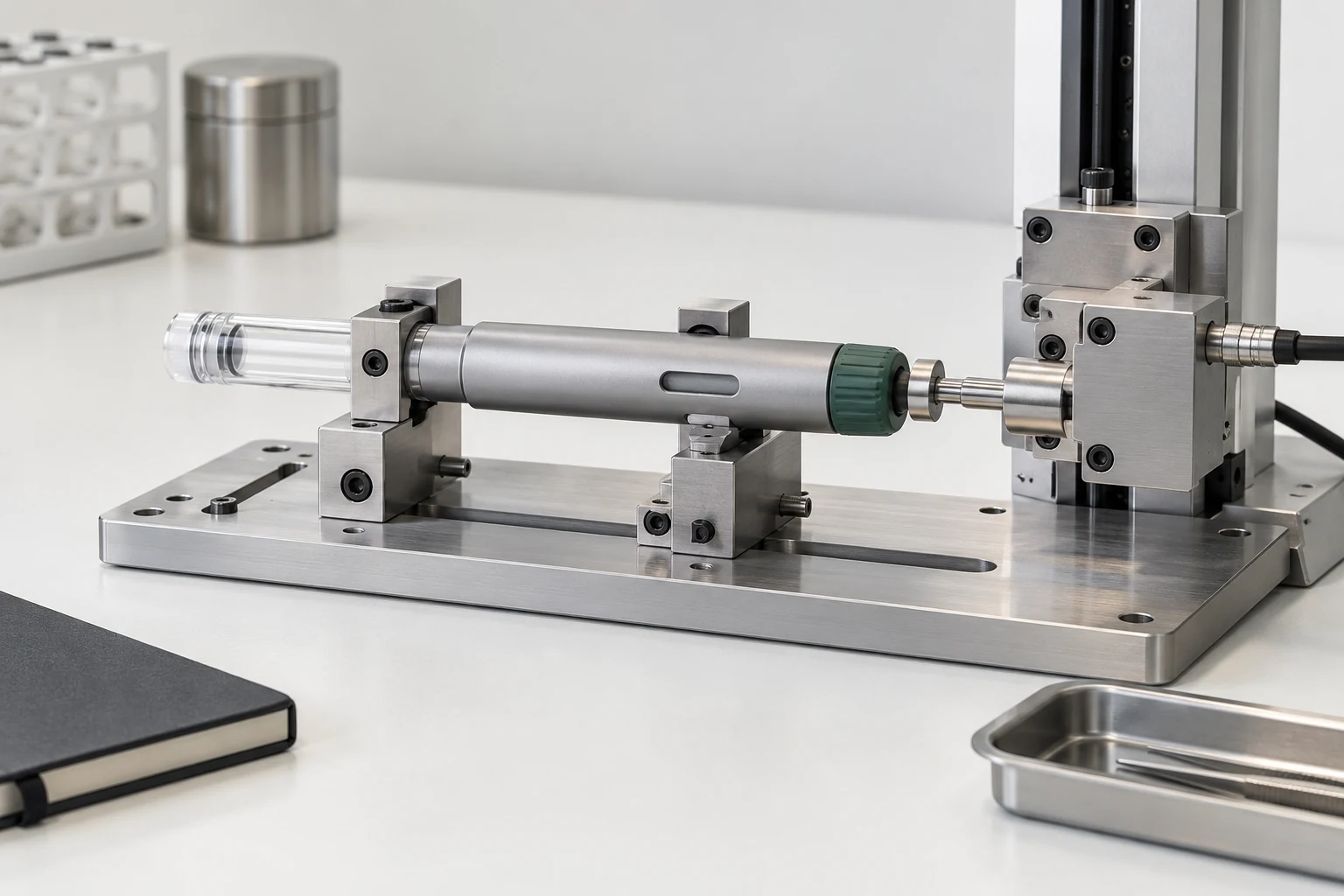
Name the force and the measurement point
A force number needs a location and an event. In a cartridge assessment, break-loose force describes the initial resistance to stopper movement; glide force describes resistance during continued travel. A finished pen adds its own drive mechanism and user interface, so a measurement at the dose button cannot automatically be treated as a cartridge result. ZwickRoell separates pen mechanics from container testing in its published technical overview. For procurement, ask the laboratory to draw the load path and identify the start and end of the reported interval. Record whether the output is a peak, a running mean or a complete force-displacement curve. Keep cap-removal force and needle-shield removal force in separate requirements. An apparently lower average can coexist with a short peak that deserves investigation. The report should make that distinction visible.
References: ZwickRoell: Testing of pen injectors and insulin pens, equipment-maker technical overview.
Freeze the cartridge, needle and operating conditions
Comparisons are useful only when the tested assemblies are identified. List the pen drawing revision, cartridge supplier and closure configuration, needle designation, fill condition and any substitute liquid. State temperature, conditioning history, actuation speed, orientation, fixture alignment and the points at which force and displacement are acquired. Use units consistently: newtons for force and the agreed speed unit for the machine. A motor displacement setting and a user delivery rate describe different quantities; the laboratory should explain any conversion. ISO 11608-1 addresses needle-based injection systems, while ISO 11608-3 addresses containers and integrated fluid paths. Their public abstracts do not supply a ready-made protocol for every commercial pen. Agree which licensed editions and amendments the laboratory will use, then map each claimed result to that controlled protocol.
References: ISO: ISO 11608-1:2022 catalogue and amendment status, ISO: ISO 11608-3:2022, containers and integrated fluid paths.
Minimum force-test brief
| Field | What to record | Why the buyer needs it |
|---|---|---|
| Measurement | Button, stopper or other named interface | Avoid mixing different force measurements |
| Configuration | Pen revision, cartridge, closure and needle | Identify the tested assembly |
| Conditions | Temperature, speed, orientation and conditioning | Interpret comparisons |
| Outputs | Raw curve, summary statistic and delivered-dose link | Review peaks and completion |
| Decision | Acceptance source, deviations and sign-off owner | Keep the conclusion within scope |
Read force curves beside delivered-dose evidence
A pen can complete a mechanical stroke without establishing every requirement of the final drug-device combination. FDA injector guidance discusses delivered-dose accuracy using the final injector and the relevant drug or biological product configuration. For an OEM review, keep mechanical screening and final-configuration evidence clearly identified. Request the full force curve, the method used to determine delivered quantity and the sequence linking the measurements. If a substitute liquid was used, ask which property it represents and which conclusions remain open. A fixture can support development work without reproducing a person's grip, dexterity or decision to stop pressing. Where use-related risks are relevant, carry those questions into the usability programme. Do not turn a successful bench trace into a claim that all users can operate the device or that a medicine has been approved.
References: FDA: Technical Considerations for Pen, Jet, and Related Injectors, June 2013.
Plan storage, temperature and repeated-use comparisons
Write a comparison matrix before the samples are conditioned. Identify the intended storage and operating conditions, the positions in the device life cycle and the assemblies that need coverage. For a reusable pen, explain how the selected use sequence represents the intended service life; for a multidose configuration, identify the cartridge position or delivery sequence being assessed. Keep a traceable unconditioned reference group where the protocol calls for one. Review whether the proposed conditions address the risks of the actual configuration, including changes in resistance after storage. The specification should identify who approves the conditions and sample rationale. Avoid accepting a fresh-sample result as an unexplained substitute for aged or transported samples. Equally, do not copy an aggressive condition from another device without asking what it represents for this project.
Put the acceptance basis in the quotation
Ask the supplier to quote a defined investigation, with the required output files and decision owner. The brief should identify who sets acceptance criteria, who supplies cartridges or representative assemblies, and who evaluates deviations. There is no universal force limit offered by this article: a limit needs a justified requirement for the specified device and users. The current ISO catalogue lists amendments to the 2022 editions of parts 1 and 3; record the exact standard designation and confirm the version relevant to the target market before commissioning work. Request the laboratory's proposed configuration list and a sample report format before approving the order. At handover, compare sample identifiers against the build record and retain any limitations on the conclusion. This gives the next engineering review usable evidence instead of an isolated pass statement.
References: ISO: ISO 11608-1:2022 catalogue and amendment status, ISO: ISO 11608-3:2022, containers and integrated fluid paths.
Questions for the testing laboratory
- Can each curve be traced to a sample, assembly revision and test run?
- Does the report identify the measurement interval and treatment of unusual traces?
- Is the substitute-liquid rationale separated from evidence for the final formulation?
- Which planned conditions and life-cycle positions remain untested?
Frequently asked questions
Is break-loose force the same as pen button force?
No. Break-loose force concerns the start of stopper movement in a defined container test. Button force is measured at the pen interface and can include the contribution of the drive mechanism. Identify both methods before comparing results.
What actuation force limit should an injection pen OEM use?
The limit must come from the device requirements and their justification, including the intended users and configuration. A value copied from another pen, a sales brochure or an unrelated study is not an acceptance basis for your project.
Can testing without the medicine support development?
It can support a clearly defined mechanical or representative-fluid investigation. The report must explain what is represented and what remains unverified. Final drug-device conclusions require evidence appropriate to the final combination and intended use.
Does an ISO 11608 report cover every cartridge and needle?
Only the configurations and justified coverage identified in the report are supported. Request the cartridge, closure, needle and device revisions, together with any bridging rationale and exclusions.
References and editorial scope
Prepared by Hytanbio Tech for B2B device procurement. Sources checked on 31 October 2026. The checklists and decision tables are editorial recommendations, not a test protocol, legal advice or evidence of Hytanbio certification. Public standard abstracts and USP previews describe scope; full controlled documents and project-specific technical review are needed for execution. No product-specific force, stability, compatibility or approval claim is made.
- FDA: Technical Considerations for Pen, Jet, and Related Injectors, June 2013
- ISO: ISO 11608-1:2022 catalogue and amendment status
- ISO: ISO 11608-3:2022, containers and integrated fluid paths
- ZwickRoell: Testing of pen injectors and insulin pens, equipment-maker technical overview