
Map the drug-contact pathway before asking for an injection pen materials certificate. Container and closure evidence, patient-contact evaluation and cosmetic housing specifications serve different purposes. Supplier data can support an assessment, but suitability for a particular formulation and use requires a documented review of the final packaging and delivery system.
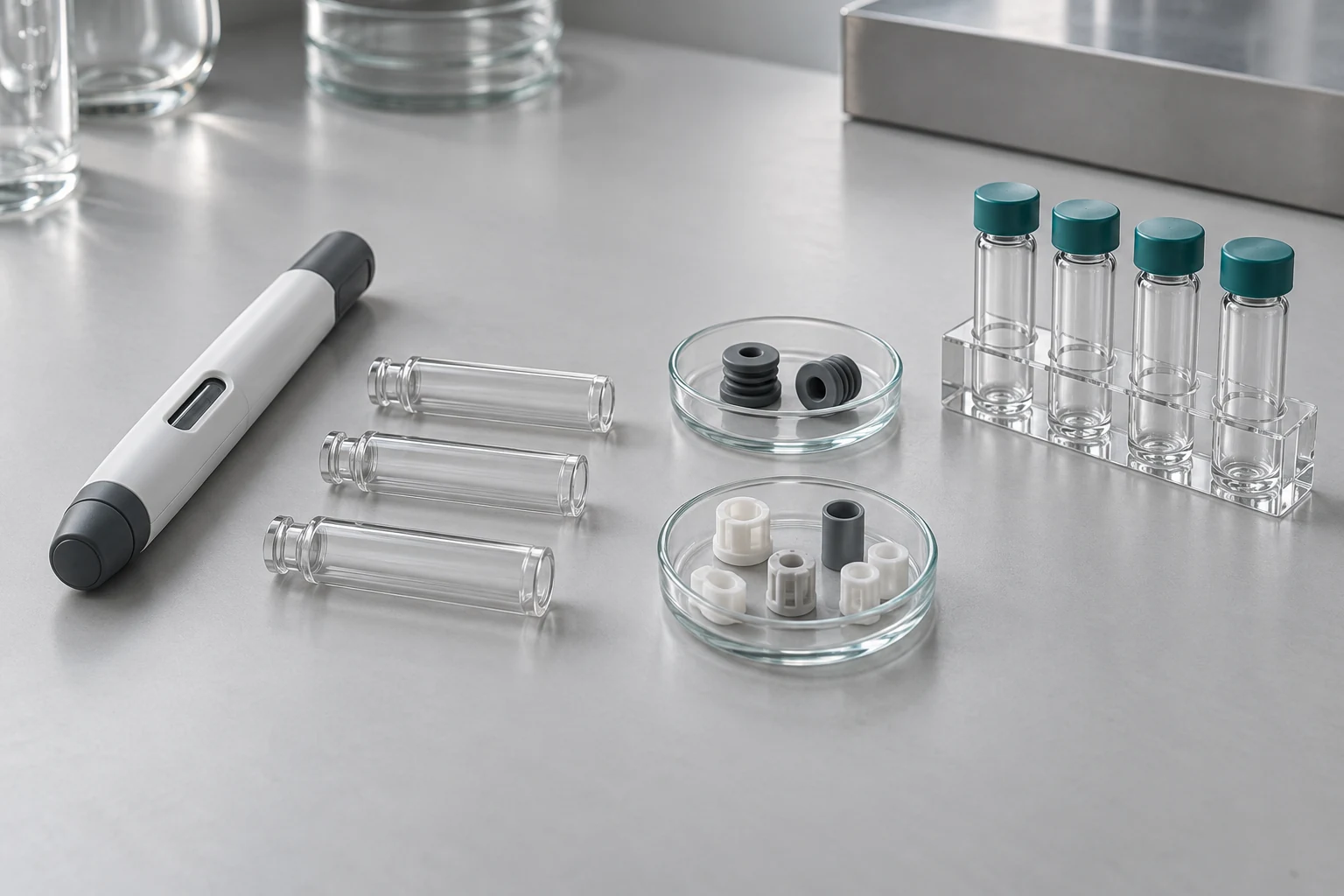
Map the formulation-contact pathway first
Start with a drawing that shows where the formulation is stored and how it reaches the delivery outlet. Identify the cartridge or syringe, closure components and any integrated fluid path, then separate those items from external housing parts. Include indirect pathways in the assessment where the proposed construction makes them relevant. ISO 11608-3 describes design verification for containers and integrated fluid paths used with needle-based injection systems. That scope helps organise a procurement conversation, but it does not establish chemical suitability for a specific drug. Ask which party supplies each contact component and who holds the underlying composition and processing information. If the OEM supplies only an empty housing or drive assembly, record that limit explicitly. A whole-pen material list without a contact map makes it difficult to tell which evidence supports which question.
References: ISO: ISO 11608-3:2022, containers and integrated fluid paths.
Distinguish extractables screening from drug-product leachables
Use the terms consistently in requests and reports. Extractables assessments investigate substances that can be released from materials under specified laboratory extraction conditions. Leachables assessments concern substances that migrate into the drug product under the relevant storage or use conditions. USP provides separate frameworks in general chapters 1663 and 1664. Its public previews also state that those chapters do not set one universal analytical method or acceptance specification for every packaging and drug-product combination. For the buyer, a supplier extraction report is a starting input: it needs a clear relationship to the component, processing state and proposed application. Ask the responsible technical team how the information will be used, what additional formulation-specific work is needed and how the study limitations will be recorded. A chapter number on a certificate is insufficient to answer those questions.
References: USP: General Chapter 1663, public purpose and scope preview, USP: General Chapter 1664, public purpose and scope preview.
Material-evidence request by question
| Question | Useful input | What it does not establish alone |
|---|---|---|
| What touches the formulation? | Contact map and controlled component list | Suitability for the specific formulation |
| What was assessed? | Sample state, supplier, revision and process description | Coverage of later changes |
| What was extracted? | Study design, analytical scope and report limitations | Actual leachables in the drug product |
| What reaches the drug? | Product-specific assessment under justified conditions | Every physical or device-performance requirement |
| Who approves the conclusion? | Named technical owner and documented rationale | Regulatory approval or certification of the supplier |
Check whether supplier data represents the supplied component
Request the report identifier, sample description, material grade, component revision and manufacturing history available for the assessed item. Establish whether the data concerns raw resin, a moulded part, a finished closure or the complete system. Processing aids, coatings and assembly operations should be visible in the evidence request where relevant, rather than hidden behind a generic material name. Use a confidentiality agreement or an agreed disclosure route when composition details cannot be sent directly to purchasing. The review record should identify what the technical assessor could examine and what remained unavailable. FDA's container-closure guidance places packaging suitability in the context of the particular drug product. A certificate of analysis for incoming material can support traceability, but it does not replace a justified assessment of the supplied finished component and proposed application.
References: FDA: Container Closure Systems for Packaging Human Drugs and Biologics.
Keep compatibility, integrity and patient-contact questions distinct
A chemical assessment does not answer every container or device question. The project may also need evidence about physical compatibility, closure integrity, delivered quantity and relevant patient-contact risks. Keep the outputs linked through the same configuration identifiers, while allowing the responsible specialists to define the appropriate methods. For a peptide or insulin injector-pen project, the product name alone cannot define the evidence plan. The formulation, concentration, excipients, container construction and intended storage or use conditions need to be identified by the product owner. Avoid transferring a statement about one medicine presentation to another formulation that happens to contain a related active substance. Review the gaps with the drug-development and device teams before commissioning more tests. This article provides a procurement framework; it neither establishes a formulation's compatibility nor supplies a toxicological conclusion.
Agree change notification and ownership before purchase
The supply agreement should identify which changes require notification and who decides whether existing evidence remains applicable. Include the relevant component sources, material formulation, coatings and processing details in that discussion. Set a route for reviewing the change before affected production lots are accepted, and retain old and new identifiers so stock can be distinguished. Ask the drug-product owner who will approve the assessment plan and interpret the results. USP's public chapter summaries place responsibility for the individual assessment with the drug-product manufacturer; an OEM can supply useful component records without assuming every development obligation. In the RFQ, separate the price of existing documents from any newly commissioned analytical work. Record exclusions and access limits early. This avoids discovering after the order that the quoted report cannot support the configuration under development.
References: USP: General Chapter 1663, public purpose and scope preview, USP: General Chapter 1664, public purpose and scope preview.
Useful records to ask the OEM for
- A revision-controlled contact-component list, with the OEM supply boundary marked.
- A description of whether each report covers raw material, a finished component or an assembled system.
- Traceable report identifiers and an agreed route to confidential technical information.
- Change-notification responsibilities and the owner of formulation-specific assessment.
Frequently asked questions
Does medical-grade plastic prove an injection pen is compatible with a drug?
No. A material description does not establish suitability for a particular formulation, component process or use condition. Review the actual contact pathway and the evidence for the supplied finished components and system.
Are USP 1663 and USP 1664 interchangeable?
No. They address extractables and drug-product leachables assessments respectively. Their public summaries provide frameworks rather than universal analytical methods or acceptance limits for every product combination.
Does every external pen housing need the same E&L programme?
The assessment should follow the relevant exposure pathways and product risks. A purely external component and a formulation-contact closure do not automatically have identical evidence needs. The responsible technical team should document the rationale.
Can an existing cartridge report support a peptide injector pen project?
It may be an input if its samples and conditions are relevant. The drug-product owner must assess its relationship to the final formulation, container, closure, processing and use conditions, and identify any additional evidence needed.
References and editorial scope
Prepared by Hytanbio Tech for B2B device procurement. Sources checked on 31 October 2026. The checklists and decision tables are editorial recommendations, not a test protocol, legal advice or evidence of Hytanbio certification. Public standard abstracts and USP previews describe scope; full controlled documents and project-specific technical review are needed for execution. No product-specific force, stability, compatibility or approval claim is made.
- USP: General Chapter 1663, public purpose and scope preview
- USP: General Chapter 1664, public purpose and scope preview
- FDA: Container Closure Systems for Packaging Human Drugs and Biologics
- ISO: ISO 11608-3:2022, containers and integrated fluid paths